Wellness Resources
Magnesium: What You Actually Need to Know and What You Can Stop Worrying About)
Magnesium is one of the most talked-about supplements in wellness, but the science is often oversimplified. For women over 50, maintaining adequate magnesium levels may support blood pressure, glucose metabolism, sleep quality, and bone health. The key is understanding what the evidence actually shows, choosing the right form, and knowing when supplementation may be appropriate.

Magnesium is one of those supplements that gets talked about constantly and understood rarely. It's been positioned as the answer to everything from insomnia to anxiety to leg cramps to bone loss, and while some of that is supported by evidence, a lot of it has been inflated well beyond what the data actually shows. So let me give you the real picture, specifically for us women over 50, where this mineral genuinely matters.

Roughly 30 to 40% of postmenopausal women have low magnesium levels, and about 20% of the general population chronically consumes less than the recommended daily amount of 320 mg. But it's not just about what you eat. Several things converge after 50 to drain your magnesium stores: if you take a proton pump inhibitor for reflux, that alone causes magnesium deficiency in approximately 20% of long-term users by reducing intestinal absorption. Thiazide and loop diuretics, commonly prescribed for blood pressure, cause the kidneys to waste magnesium. Type 2 diabetes impairs magnesium reabsorption. And your gut simply absorbs less magnesium as you age. So even if your diet hasn't changed, your magnesium status probably has.

Blood pressure. A 2025 meta-analysis of 38 randomized controlled trials found that magnesium supplementation reduced systolic (the top number) blood pressure by about 2.8 mmHg and diastolic (the bottom number) by about 2 mmHg, with larger effects in people who already had hypertension or documented low magnesium. That's modest, but clinically meaningful as an adjunct to medication, not a replacement for it.
Glucose metabolism. This is where the data gets genuinely compelling for women over 50. Studies have found that higher magnesium intake is associated with a 22% lower risk of developing type 2 diabetes, with about a 6% risk reduction per additional 100 mg per day. In people with type 2 diabetes, a dose-response meta-analysis of 18 RCTs showed that 500 mg/day elemental magnesium reduced HbA1c by 0.73%. Supplementation for four months or longer also improved insulin resistance in both diabetic and non-diabetic subjects. Given that menopause itself increases insulin resistance, this connection deserves more attention than it gets.
Sleep. A meta-analysis of three randomized controlled trials in older adults found that magnesium reduced the time to fall asleep by about 17 minutes compared with a placebo. That's real, but the effect on total sleep time was not statistically significant. A large observational study found that people with the highest magnesium intake had 36% lower odds of sleeping less than seven hours. The mechanism makes biological sense: magnesium modulates GABA-A receptors and blocks NMDA receptors, both of which reduce neuronal excitability and promote deeper sleep. But I want to be honest: the overall quality of the sleep RCT data remains low. Promising, biologically plausible, but not definitive.
Bone Health. The Women's Health Initiative, which studied over 73,000 postmenopausal women, found that hip bone mineral density was about 3% higher in women consuming more than 422 mg per day than in those consuming less than 206 mg per day. But here's the important nuance: no randomized controlled trial has ever evaluated magnesium's effect on fracture risk as a primary endpoint, and if your magnesium stores are already adequate, supplementation does not further increase bone density. More is not better here.

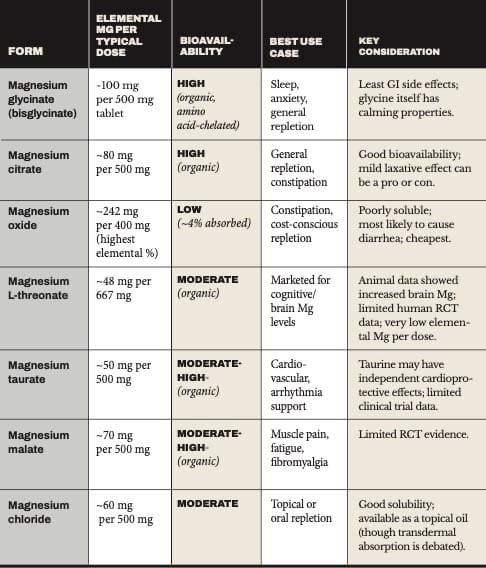
The most common side effect is dose-related diarrhea. If you've experienced loose stools from magnesium, you may have been taking too much at once or using a poorly absorbed form (magnesium oxide is the most common culprit). Splitting your dose and choosing magnesium glycinate or citrate typically helps.
More importantly, if you have kidney disease, particularly stage 4 or 5 with an eGFR below 30, magnesium supplementation can be genuinely dangerous. Your kidneys are responsible for clearing excess magnesium, and when that clearance system is compromised, magnesium can accumulate to levels that cause low blood pressure, nausea, and cardiac conduction problems. If you have CKD, do not supplement without your nephrologist's guidance.
There's also a paradox worth knowing: while low magnesium is harmful to bone, very high magnesium levels have been associated with reduced bone density in postmenopausal women. This suggests a U-shaped relationship in which both too little and too much can be problematic.

Before we talk about which form to take, I want to be transparent about something that's often skipped: serum magnesium is an imperfect marker. Only about 1% of total body magnesium circulates in your blood, which means a normal serum level does not exclude tissue depletion. If you're on a PPI plus a diuretic — a combination that dramatically increases hypomagnesemia risk — it's worth asking your doctor about checking RBC magnesium or a 24-hour urine magnesium, which are more informative in borderline cases. And if you have chronic kidney disease with an eGFR below 30, please do not supplement without your nephrologist's guidance, because your kidneys are responsible for clearing excess magnesium, and when that clearance is compromised, accumulation can affect cardiac conduction. This is one of those rare situations where a supplement can be genuinely dangerous.
Form is where most people go wrong. NEJM's review of magnesium disorders makes it clear that organic salts — glycinate, citrate, aspartate, gluconate — are more effectively absorbed than inorganic salts like magnesium oxide. Oxide has the highest elemental magnesium per tablet, which looks good on a label, but only about 4% of it is actually absorbed, making it primarily useful as a laxative.
The forms I recommend for most women are glycinate and citrate: glycinate because the amino acid chelate allows efficient absorption with minimal GI side effects, and citrate because it has excellent bioavailability with the added benefit of mild laxative properties if constipation is part of your picture. (And if you're postmenopausal and taking calcium supplements, odds are fairly good that it is.) Timing matters too: evening dosing, separated from levothyroxine, bisphosphonates, and tetracycline antibiotics by at least two hours, maximizes both absorption and the sleep benefit.

This is where things get murky, and I want to be straight with you about it. The FDA does not assess supplements before they come to market, which means quality standards vary widely across brands and price points. Numerous independent analyses of random supplement samples have found that significant percentages either don't contain the dose claimed on the label or contain contaminants we have no business putting in our bodies, and spending more money does not guarantee you're getting a better product. That reality doesn't mean you throw your hands up — it means you do your homework about where something is made, what's actually in it, and whether third-party testing backs up what the label promises.
I have high standards for supplements, and you should too. When I came across JSHealth*, I spent real time investigating and tracking changes before I agreed to a partnership. Once it passed my litmus test, I agreed to share it with you.

JSHealth was developed by expert nutritionist Jessica Sepel and is manufactured in NSF GMP-certified facilities with ISO/IEC-accredited testing, formulated with minimal fillers and non-GMO, sustainably sourced ingredients, and certified by the Clean Label Project for purity and safety. That combination of third-party testing, transparent sourcing, and meaningful quality standards is exactly what I look for.
Most magnesium supplements use a single form, often oxide, because it's cheap and allows a high-looking number on the label. JSHealth Advanced Magnesium+ uses three bioavailable forms: magnesium glycinate, magnesium citrate, and magnesium amino acid chelate. From a clinical standpoint, this approach makes sense: different forms have different absorption pathways and different tissue affinities, so a combination formula is more likely to address varied physiological needs than any single form alone.
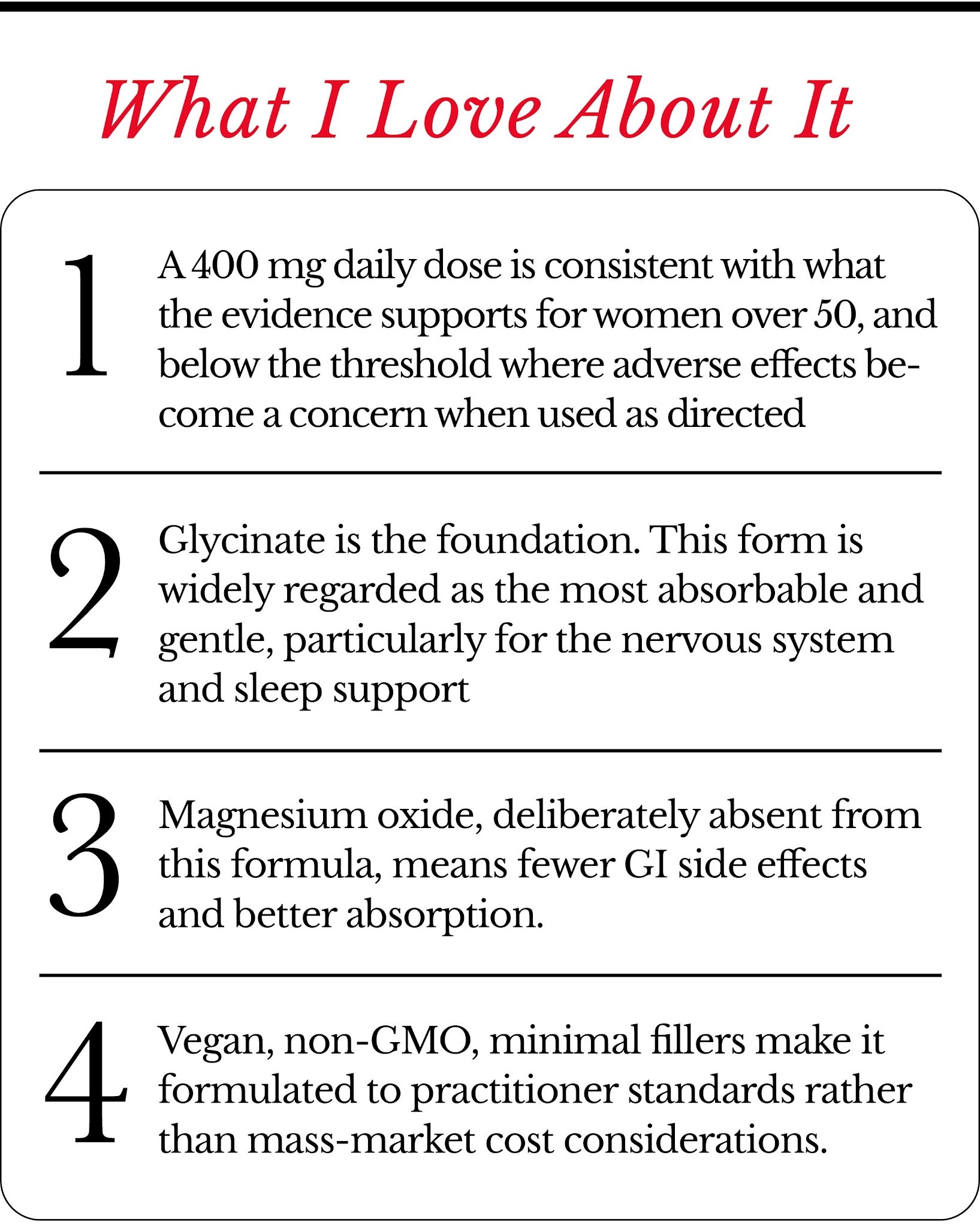
From my own experience, this is a supplement you can actually feel the difference with. That matters to me because I'm skeptical of anything I can't notice working. I sleep better. I feel more physically settled in the evenings. That's not a marketing claim; it's just what I've observed, and it's consistent with what the biology would predict given the forms and dose involved. (If you try it and notice the same thing, I'd genuinely love to hear from you.)

Magnesium is one of the most evidence-supported supplements for women over 50, but the form, dose, and your individual health profile matter more than any headline or social media recommendation. Aim for 350 to 400 mg per day total, choose a well-absorbed form, take it in the evening if sleep is your primary concern, and talk to your doctor if you have kidney disease or take medications that affect electrolyte balance.
Evidence-supported does not mean take as much as you want. Nuance applies here, as it does everywhere.